

We have all been there. You are running late, navigating an unfamiliar city using your phone’s GPS, trying to coordinate a meetup via text, and checking your flight status. Suddenly, you look at the top right corner of your screen: 12% battery. A cold sweat sets in.
In the 21st century, low battery anxiety is a universally recognized psychological phenomenon. Our smartphones have become our external brains, housing our money, our maps, our memories, and our lifelines to the world. When they die, we feel marooned.
Enter the humble power bank—the unsung hero of modern mobility.
Today, portable chargers are so ubiquitous they are sold in airport vending machines, grocery store checkout lines, and gas stations. They come in shapes ranging from sleek, credit-card-sized wafers to massive blocks capable of jump-starting a car or keeping a laptop running for days.
But where did this indispensable gadget come from? It didn’t emerge overnight from a Silicon Valley tech incubator, nor was it conceived by a smartphone giant like Apple or Samsung. The true history of the power bank is an extraordinary journey that begins in the frozen wastes of Antarctica, winds through a revolution in consumer electronics, and lands right in your pocket.
In this deep dive, we will explore the complete, untold history of the power bank, dissect the intricate science of how these portable life-rafts actually work, and look ahead to the next frontier of mobile energy.
Part 1: The Frozen Origin Story (2001)
To understand why the power bank was invented, we have to look back to the year 2001. This was an era before smartphones. The mobile landscape was dominated by “brick” phones like the Nokia 3310, which could famously last a week on a single charge because their monochrome screens and text-only networks demanded very little electricity.
Portable energy wasn’t a mass-market problem yet. If your phone ran out of juice, you simply swapped out the removable battery or waited until you got home to plug it into the wall.
However, a highly specific crisis was brewing at the bottom of the world.
The Antarctic Expedition Dilemma
In late 2001, a Chinese scientific research expedition was preparing to venture into the brutal, sub-zero wilderness of Antarctica. Among their gear were heavy, professional-grade video cameras intended to document the expedition’s findings.
As the team tested their equipment, they hit a catastrophic roadblock: the extreme cold.
Batteries rely on chemical reactions to produce electricity. When temperature drops dramatically, these chemical reactions slow down to a crawl. In the freezing Antarctic climate, the internal resistance of the video camera batteries skyrocketed, causing their voltage to plunge. Cameras that were supposed to run for hours on a full charge were dying within minutes of being exposed to the elements.
The scientists were facing a complete documentation blackout. Desperate for a solution, they approached a young, ambitious Chinese consumer electronics and battery manufacturing company named Pisen.
The mandate was simple but seemingly impossible: Build a portable, external power source that can withstand sub-zero temperatures and keep our video cameras alive.
The “Pescador” Prototype
Pisen’s engineering team didn’t have the luxury of time or pre-existing industry blueprints. They had to improvise using what was available on their workshop shelves.
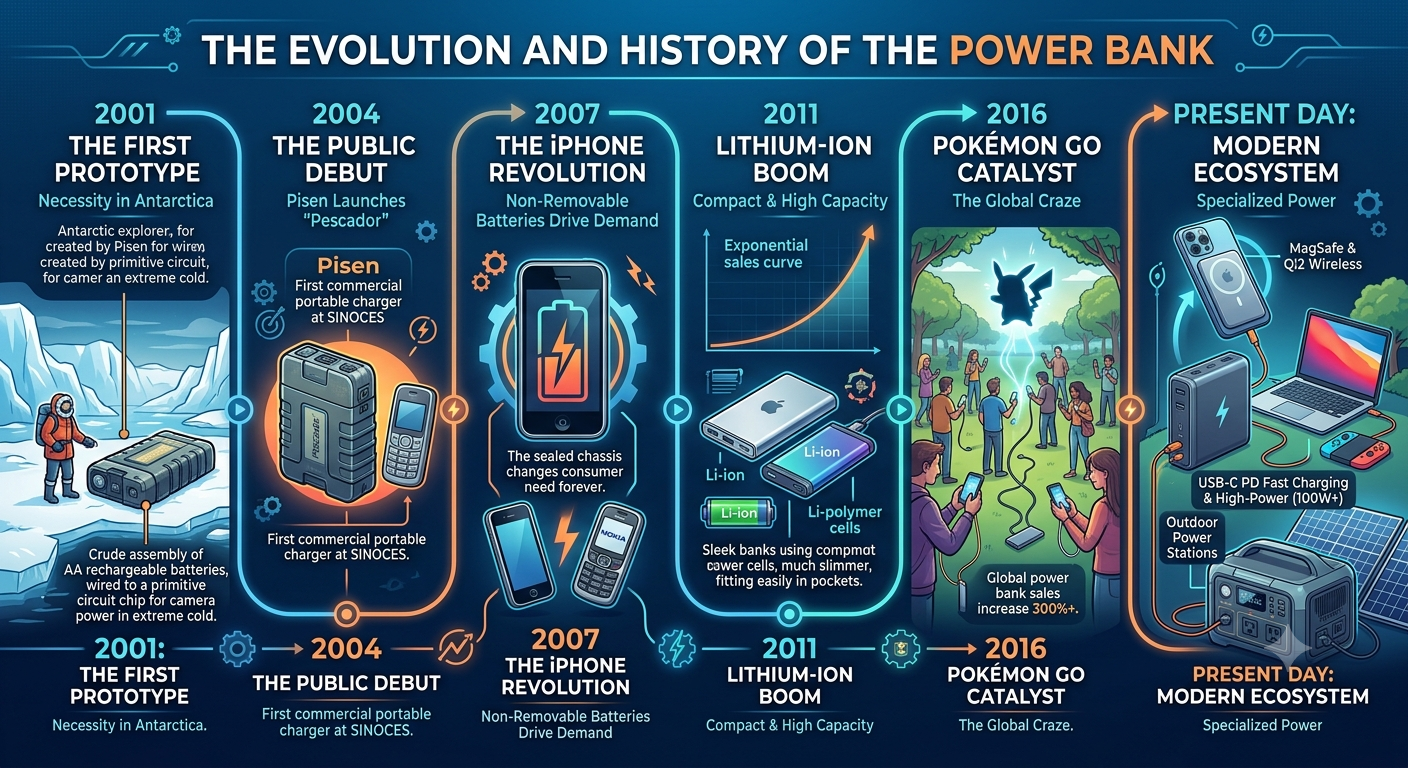
The very first power bank prototype was an unglamorous, industrial-looking contraption. The engineers took a cluster of standard, cylindrical AA rechargeable batteries and wired them together in a combination of series and parallel circuits to achieve the necessary voltage and capacity. They housed this battery cluster inside a rudimentary casing and, crucially, developed a primitive circuit control chip to regulate the electrical output so it wouldn’t fry the sensitive video equipment.
The result was heavy, clunky, and visually resembled a science fiction prop or a makeshift explosive device more than a sleek tech accessory. It was named the Pescador.
Despite its aesthetic shortcomings, the Pescador was a triumph of functional engineering. When the research team hit the Antarctic ice, the external battery pack performed flawlessly. By keeping the primary battery pack insulated or fed with a constant stream of external current, the cameras stayed operational.
Pisen had successfully invented the world’s first functional, external mobile power bank.
Part 2: The Consumer Evolution (2004–2010)
While the Antarctic expedition proved that portable external power was possible, the global consumer market wasn’t immediately convinced it was necessary. In the early 2000s, carrying an extra brick just to charge your phone seemed like an unnecessary burden.
Pisen recognized the long-term potential of their creation. In 2004, they officially commercialized the technology and debuted the first consumer-facing power bank at the China International Consumer Electronics Show (SINOCES).
The early consumer reaction was muted. Tech enthusiasts found it fascinating, but the average consumer looked at the bulky unit, looked at their long-lasting Nokia or Motorola flip phone, and asked, “Why would I ever need to carry that?”
Two seismic shifts in the tech industry were about to turn that skepticism into desperation.
1. The Death of the Removable Battery
Throughout the late 1990s and mid-2000s, standard practice for power users was carrying a spare, fully-charged phone battery in their pocket or purse. If your phone died, you popped off the plastic back cover, yanked out the dead battery, slapped in the fresh one, and booted the phone back up. It took 30 seconds.
Then, on January 9, 2007, Steve Jobs took the stage at the Macworld Expo and changed everything.
+--------------------------------------------------------+
|             THE SMARTPHONE PARADIGM SHIFT              |
+--------------------------------------------------------+
|  PRE-2007 ERA                  |  POST-2007 ERA        |
|  - Monochrome/Small screens   |  - Huge touch displays |
|  - Text/Voice emphasis         |  - Constant data use  |
|  - Removable batteries         |  - Sealed chassis     |
|  - Multi-day battery life      |  - Single-day life    |
+--------------------------------------------------------+
The original iPhone was a triumph of industrial design, but it came with a massive structural trade-off: a sealed aluminum and glass chassis with a non-removable battery.
Apple prioritized a slim profile, premium materials, and structural integrity over user-swappable parts. Suddenly, the “spare battery safety net” was gone. If your iPhone ran out of juice in the middle of the day, you were tethered to a wall outlet—or you had to find an external power source that could plug directly into the charging port.
2. The App Explosion and Mobile Data
It wasn’t just the sealed designs that starved phones of energy; it was what we were doing with them.
The launch of the Apple App Store in 2008 and the rapid rise of Google’s Android operating system transformed phones from simple communication tools into pocket-sized supercomputers. We stopped just texting and started streaming music, scrolling through image-heavy social media feeds, navigating via real-time GPS, and rendering 3D mobile games.
The math was brutal. Battery technology, which relies on chemical metallurgy, improves at a notoriously slow rate (roughly 5% to 8% per year). Meanwhile, mobile processor speeds, screen resolutions, and cellular data consumption were expanding exponentially.
By 2010, the “one-day battery life” became the industry standard. If you used your phone heavily, it might not even make it to lunchtime. The market conditions were finally perfect: the power bank went from an Antarctic oddity to a modern consumer necessity.
Part 3: The Golden Age and the Cultural Catalysts (2011–2018)
As demand surged in the 2011–2015 era, a gold rush began in the hardware world. Hundreds of manufacturers rushed into the portable power space. Prices plummeted, capacities skyrocketed, and the technology inside the power banks evolved rapidly.
From Ni-MH to Lithium-Ion
Early power banks suffered from the limitations of Nickel-Metal Hydride (Ni-MH) or cheap, heavy cylindrical Lithium-Ion cells (specifically the 18650 format, which looked like oversized AA batteries). This made early high-capacity power banks thick, cylindrical, and uncomfortably heavy.
However, the rapid scaling of the tablet and ultra-thin laptop markets led to the mass production of Lithium-Polymer (Li-Po) batteries. Unlike their rigid predecessors, Li-Po batteries could be manufactured in flat, ultra-thin, flexible sheets.
Power bank manufacturers quickly adopted Li-Po technology. Suddenly, a 10,000mAh power bank didn’t have to look like a dynamic brick; it could be styled like a sleek, anodized aluminum slab that sat elegantly underneath an iPhone or Samsung Galaxy. Brands like Anker, RAVPower, Mophie, and Xiaomi became household names by capitalizing on this design revolution.
The Pokémon GO Phenomenon (2016)
If the iPhone built the foundation for the power bank market, a single mobile game turned it into a full-blown global frenzy. In July 2016, Niantic launched Pokémon GO.
The augmented reality game required players to walk around the real world tracking virtual creatures. To do this, the app required an unprecedented cocktail of hardware resources simultaneously:
- It kept the screen on at maximum brightness continuously.
- It constantly Pinged GPS satellites for real-time location tracking.
- It utilized the phone’s camera for the AR overlay.
- It kept the cellular modem pinned to download map data.
- It ran the graphics processing unit (GPU) to render 3D elements.
It was the ultimate battery killer. A fully charged, brand-new smartphone would routinely hit 0% within two hours of gameplay.
       POKÉMON GO: THE ULTIMATE BATTERY DRAIN

       [ Screen at Max Brightness ]  ──┐
       [ Constant GPS Tracking ]     ──┼──> [ 100% to 0% in ~2 Hours ]
       [ Rear Camera AR Feed ]       ──┼──> [ POWER BANK DEMAND +300% ]
       [ Continuous Cellular Data ]  ──┘
The global response was instantaneous. Millions of players realized they couldn’t participate in this cultural phenomenon without an external power source. During the summer of 2016, electronics retailers reported power bank sales spikes of over 300%.
Players would walk through public parks with their phones in one hand and a power bank clutched tightly in the other, connected by a dangling USB cable. The power bank was no longer just an emergency accessory for business travelers; it was an active lifestyle enabler.
Part 4: The Physics and Engineering of Portable Power
To look at a power bank, you might think it is just a battery box with a USB port slapped on the front. In reality, a power bank is a highly sophisticated, miniature electrical substation that performs delicate, high-stakes energy management every second it is plugged in.
To appreciate why power banks are so remarkable—and why poor quality ones can be dangerous—we need to look under the hood at the core components and chemical physics that make them work.
1. The Anatomy of a Power Bank
A modern power bank consists of three core components:
- The Battery Cells: The storage reservoir where the actual energy is held chemically.
- The Printed Circuit Board (PCB): The intellectual core that regulates the flow of electricity in and out.
- The Enclosure: The protective outer shell (typically polycarbonate or structural aluminum) designed to protect the internal components from drops, impacts, and thermal build-up.
2. The Chemistry: Inside the Cells
Most power banks use Lithium-Ion (Li-ion) or Lithium-Polymer (Li-Po) cells. These batteries store energy through the movement of lithium ions between a positive electrode (cathode) and a negative electrode (anode).
- When charging the power bank: Lithium ions move from the cathode to the anode, storing electrical energy as chemical potential.
- When discharging (charging your phone): The ions rush back to the cathode, releasing electrons that flow through the circuit board and down the cable into your phone.
Battery capacity is measured in Milliampere-hours (mAh). A standard smartphone battery typically holds between 3,000mAh and 5,000mAh. A standard pocket-sized power bank usually boasts a capacity of 10,000mAh, theoretically providing enough juice to fill a dead phone roughly two times over.
3. The Electronics: The Magic of the PCB
This is where the real engineering happens. A raw lithium battery cell operates at a nominal voltage of roughly $3.7\text{V}$. However, standard USB charging protocols traditionally require a constant output of $5.0\text{V}$ (and modern fast chargers can scale this up to $9\text{V}$, $12\text{V}$, or even $20\text{V}$).
If you wired a $3.7\text{V}$ lithium cell directly to a USB port, it wouldn’t be able to charge your phone effectively because the voltage wouldn’t be high enough to overcome the internal resistance of the phone’s charging circuit.
+-----------------------------------------------------------------------+
|                       VOLTAGE STEP-UP PROCESS                         |
+-----------------------------------------------------------------------+
| [ Internal Battery Cell ] ---> [ Boost Converter ] ---> [ USB Output ]|
|          3.7V                      On the PCB                5.0V     |
+-----------------------------------------------------------------------+
The PCB contains a DC-to-DC Boost Converter. When you plug your phone in, this converter steps up the battery’s raw $3.7\text{V}$ output to a clean, stable $5.0\text{V}$ (or higher). Conversely, when you plug the power bank into the wall to recharge it, the PCB features a buck converter that steps down the wall adapter’s higher voltage to safely replenish the internal cells.
4. The Law of Conservation of Energy: Why You Lose Juice
A common consumer complaint is: “My power bank has a 10,000mAh capacity, and my phone has a 5,000mAh battery, so why can’t I get exactly two full charges out of it?”
The answer lies in the fundamental laws of physics. No energy transfer is 100% efficient. When a power bank charges a phone, it loses energy due to several factors:
- Voltage Conversion Loss: The process of stepping $3.7\text{V}$ up to $5\text{V}$ inside the power bank, and then stepping it back down to roughly $4.2\text{V}$ inside the smartphone’s internal charging circuitry, consumes energy.
- Thermal Loss (Heat): Electrical resistance in the circuit boards, wires, and internal battery cells generates heat. Any energy that escapes your power bank as warmth is energy that cannot be converted into phone battery power.
- Chemical Inefficiency: The conversion of chemical energy back into electrical energy, and vice versa, is inherently imperfect.
Because of these factors, most high-quality power banks operate at an efficiency rate of roughly 65% to 70%. Therefore, a 10,000mAh power bank actually delivers roughly 6,500 to 7,000mAh of actual energy to your phone’s battery. The missing 30% isn’t defective manufacturing; it’s simply the price we pay to the laws of thermodynamics.
Part 5: The Safety Imperative: Why Cheap Chargers Explode
You have likely seen news headlines or airport security warnings about lithium-ion batteries catching fire or exploding. Because power banks hold large amounts of chemical energy in highly compressed spaces, safety engineering is the most critical element of their design.
To appreciate why premium power banks cost more than generic gas-station alternatives, we must examine the protective layers engineered into modern portable chargers.
The Threat of Thermal Runaway
The nightmare scenario for any lithium battery is a phenomenon known as thermal runaway.
If a battery cell is punctured, crushed, exposed to extreme heat, or subjected to electrical overcharging, an internal short circuit can occur. This short circuit generates intense heat. If the temperature hits a critical threshold (typically around $130^\circ\text{C}$ to $150^\circ\text{C}$), it triggers an exothermic chemical reaction inside the cell.
The cell begins creating its own heat, causing the temperature to spike even faster. This melts the internal plastic separators, causing more short circuits, releasing toxic, flammable gases, and eventually resulting in a violent fire or explosion.
The Guardians on the Board
To prevent thermal runaway, a reputable power bank’s PCB is packed with dedicated protection circuits:
- Overcharge Protection: Stops the inflow of current the moment the internal lithium cells hit their maximum safe capacity during a recharge.
- Over-Discharge Protection: Prevents the cells from draining completely to 0%. True zero voltage permanently damages the internal chemical structure of a lithium cell, making it unstable when recharged. The PCB cuts power while a safe buffer of residual charge still remains.
- Current/Short-Circuit Monitoring: Instantly severs the connection if it detects an unexpected surge in current, protecting both the power bank and your connected smartphone.
- NTC Thermistors: Temperature sensors positioned directly against the battery cells. If the power bank gets too hot while charging your phone in a hot car, the thermistor tells the brain to dial back the power flow or shut down entirely until things cool down.
This is why buying generic, unbranded power banks can be risky. To hit rock-bottom prices, cut-rate manufacturers often omit these vital safety sensors and use degraded, b-grade, or recycled battery cells, transforming a helpful accessory into a potential hazard.
Part 6: Modern Features and the Current Ecosystem
As we navigate the current landscape of mobile technology, the power bank has shifted from a basic utilitarian tool into a highly specialized ecosystem designed around speed, convenience, and versatility.
If you walk into an electronics store today, you won’t just find standard black charging bricks. The market has splintered into several cutting-edge form factors and advanced charging architectures.
1. Fast Charging Protocols (USB-PD and QC)
The days of leaving your phone plugged into an external pack for four hours just to get a partial charge are gone. Modern power banks rely heavily on advanced communication protocols to deliver energy at blistering speeds.
The industry standard is USB Power Delivery (USB-PD). Through a USB-C port, the power bank communicates directly with your device’s internal power management chip. They negotiate the optimal combination of voltage and current.
+--------------------------------------------------------+
|             POWER BANK REVOLUTION: PERFORMANCE         |
+--------------------------------------------------------+
|  OLD STANDARD (USB-A)          |  MODERN STANDARD (USB-C)|
|  - 5 Watts Fixed Output        |  - 100+ Watts Dynamic   |
|  - Slow, basic charging        |  - USB Power Delivery   |
|  - Phones only                 |  - Phones, Laptops, Mac |
+--------------------------------------------------------+
While an old-school USB-A port could only put out a meager $5\text{W}$ of power, modern USB-C PD power banks can scale up to $20\text{W}$, $45\text{W}$, $65\text{W}$, or even $140\text{W}$. This means you can use a high-end portable charger to power not just your phone, but an entire Apple MacBook Pro, a Nintendo Switch, or a high-performance Windows workstation while sitting on an airplane.
2. Magnetic Wireless Charging (The MagSafe Era)
With Apple’s reintroduction of MagSafe and the universal adoption of the Qi2 wireless standard, power banks have shed their tethers.
Magnetic wireless power banks snap directly onto the back of your smartphone, aligning the internal copper induction coils perfectly every time. This eliminates the need to carry loose cables in your pocket and protects the phone’s physical charging port from long-term wear and tear.
3. High-Capacity Power Stations
On the opposite end of the spectrum are massive, rugged power stations. While still technically power banks, these large units feature capacities measured in Watt-hours (Wh) rather than milliampere-hours.
Equipped with built-in solar panel inputs, traditional AC wall outlets, and heavy-duty handles, these power banks have become essential gear for off-grid camping, outdoor film production, and residential emergency backup systems during severe weather events.
Part 7: The Next Frontier: Solid-State and the Future of Energy
The story of the power bank is far from over. We are currently standing on the precipice of the next major technological leap in energy storage: The Solid-State Battery.
The Problem with Liquid Lithium
For all their efficiency, modern lithium-ion and lithium-polymer batteries have a built-in limitation: they use a liquid or gel electrolyte to move ions between electrodes. This liquid is volatile, highly flammable, and degrades over time, which is why your power banks lose their maximum holding capacity after a year or two of heavy use.
The Solid-State Promise
Researchers and tech giants are investing billions into developing commercial solid-state batteries. By replacing the liquid electrolyte with a solid layer of ceramic, glass, or advanced polymer, the next generation of power banks will unlock remarkable performance upgrades:
- Double the Energy Density: Solid-state technology can pack up to twice as much power into the same physical space. A future power bank could match the 10,000mAh capacity of today’s models while being thin enough to slide cleanly into a standard credit card wallet slot.
- Near-Instant Charging: Without the risk of overheating liquid components, solid-state cells can handle massive electrical currents, allowing a power bank to recharge from 0% to 100% in just a few minutes.
- Absolute Safety: Solid-state batteries are non-flammable and cannot experience thermal runaway, completely eliminating the risk of fire or explosions on flights and in crowded transit systems.
Graphene Integration
In tandem with solid-state research, graphene is already starting to enter the high-end power bank market. Graphene, a single layer of carbon atoms arranged in a hexagonal lattice, is an extraordinary conductor of electricity and heat.
By mixing graphene composites into battery electrodes, manufacturers can create power banks that run remarkably cool and boast cycle lifespans five times longer than standard lithium chargers.
Conclusion: The Quiet Revolution in Our Pockets
The next time you pull a power bank out of your backpack, plug in your phone, and watch that reassuring green battery icon light up, take a moment to look at the little device in your hand.
You are holding a direct descendant of a rugged survival tool designed for Antarctic explorers facing down one of the most hostile environments on earth. It is a device that grew up alongside the smartphone revolution, transformed our global pop-culture habits, and relies on precise atomic engineering and strict physics to operate safely.
The power bank is a testament to the power of human ingenuity—a quiet technological revolution that ensures no matter how fast our world moves, we always stay connected.
Ultimate Power Bank Buying Guide & Best Practices
To close out this deep dive, here is a practical checklist to ensure you get the absolute most out of your portable power tech.
1. How to Choose the Right Capacity
- 5,000mAh: Best for ultra-light daily commuting. It will give most modern smartphones one near-full charge.
- 10,000mAh: The sweet spot for general travel. Easily slips into a pocket and provides 1.5 to 2 full charges.
- 20,000mAh+: Ideal for weekend camping trips or powering multiple devices (tablets, headphones, phones). Note that 27,000mAh (100 Watt-hours) is the maximum legal limit allowed in carry-on luggage by most global aviation authorities.
2. Tips to Extend the Lifespan of Your Power Bank
- Avoid Extreme Temperatures: Do not leave your power bank on a car dashboard in the summer or in an unheated garage during winter. Extreme heat degrades battery health rapidly, and extreme cold reduces operational efficiency.
- Don’t Leave It Completely Empty: If you store a power bank away for months with 0% battery, the chemical cells can degrade to a state of deep discharge, rendering the device unable to hold a charge ever again. Store it at roughly 50% to 70% capacity if you plan to put it away long-term.
- Use High-Quality Cables: A damaged or low-quality charging cable can cause massive electrical resistance, converting precious energy into useless heat and slowing down your charge times significantly. Always pair your power bank with a certified, high-quality cable.